
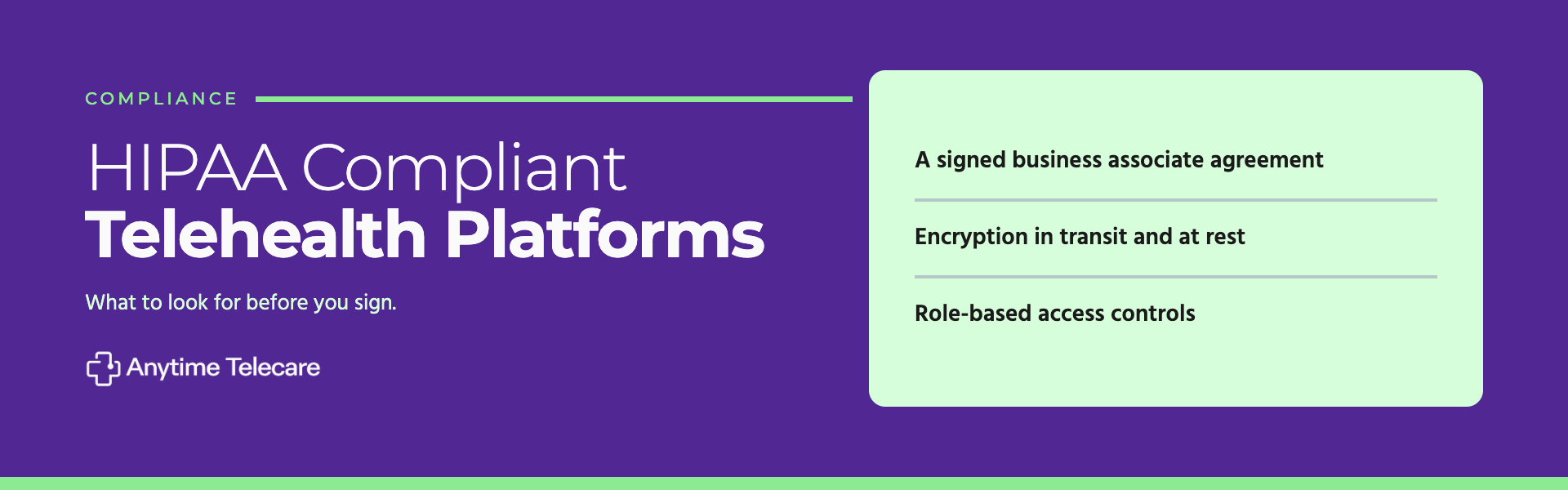
HIPAA compliant telehealth platforms share four non-negotiable traits: a signed Business Associate Agreement, encryption in transit and at rest, role-based access controls, and auditable logs. Everything else, including video quality and scheduling features, is a product decision rather than a compliance one.
This guide covers what to verify before you sign, which claims to distrust, and the questions that separate genuine compliance from marketing language.
What Makes Telehealth Platforms HIPAA Compliant?
Compliance is not a feature you switch on. Instead, it is a combination of legal agreements and technical safeguards.
A signed Business Associate Agreement
Any vendor that touches protected health information on your behalf must sign a BAA before work begins. The agreement defines permitted uses, security obligations, and breach notification timelines. The HHS sample provisions outline what belongs in one.
Encryption in transit and at rest
Video, audio, chat, and stored recordings all need protection. Ask specifically about stored data, since many vendors encrypt the session but treat archives less carefully.
Access controls and audit logs
Only authorized users should reach patient data, and every access should be recorded. Without logs, you cannot investigate an incident or demonstrate diligence.
Minimum necessary data practices
The platform should collect only what the encounter requires. More data means more exposure.
Why a BAA Alone Is Not Enough
A signed agreement is mandatory. However, it is not evidence that a vendor’s day-to-day practices are sound. Compliance is continuous work: risk analysis, safeguards, staff training, documentation, monitoring, and correction.
Therefore, ask for evidence rather than assurances. Request the vendor’s most recent risk assessment summary, their breach history, and their staff training cadence.
Questions to Ask Before Choosing a Platform
- Will you sign a BAA, and can we review it before purchase?
- Is data encrypted at rest as well as in transit?
- Where are recordings and transcripts stored, and for how long?
- Who on your team can access patient data, and is that logged?
- What is your breach notification timeline?
- Have you had a reportable breach in the last three years?
If a vendor cannot answer these quickly, that is itself informative.
Compliance Gaps That Appear After Hours
Daytime workflows usually get the most scrutiny. Meanwhile, after-hours coverage often runs through a separate vendor with weaker controls.
Consider how many parties touch a single overnight patient call. An answering service may take the message. A paging system may relay it. A provider may return the call from a personal phone. Each hop is a place where protected health information can escape your compliance perimeter.
For that reason, evaluate after-hours vendors with the same rigor as your primary platform. Our overview of nurse triage explains how clinical coverage and documentation stay inside one auditable system.
Red Flags in Vendor Compliance Claims
Certain phrases signal a vendor that has not done the work. Watch for these:
- “HIPAA certified.” No such certification exists. HHS does not certify vendors.
- “Bank-level encryption.” This is marketing language, not a technical specification. Ask for the actual standard.
- “We are compliant because our data center is.” Infrastructure compliance does not transfer to the application layer.
- Refusal to share the BAA before purchase. You should be able to review terms during evaluation.
Compliance Is Not Only Technical
Technical safeguards get most of the attention. However, administrative and physical safeguards carry equal weight under the Security Rule.
Administrative safeguards cover workforce training, access management, and incident response. Physical safeguards cover facility access and device controls. Consequently, a platform with excellent encryption can still create exposure if its staff are untrained or its offboarding is sloppy.
Ask how often staff are trained, how access is revoked when someone leaves, and who is accountable for compliance internally.
Building an Evaluation Record
Document your diligence as you go. Keep the signed BAA, the vendor’s security documentation, your notes from the evaluation, and the date of each review.
If an incident occurs later, that file demonstrates reasonable diligence. Without it, you are reconstructing decisions from memory under pressure.
Frequently Asked Questions
What makes a telehealth platform HIPAA compliant?
The vendor must sign a Business Associate Agreement, encrypt data in transit and at rest, enforce access controls, and maintain audit logs. Video quality and features are irrelevant to compliance.
Is a signed BAA enough to prove compliance?
No. A BAA is a legal requirement, not proof of practice. Compliance is an ongoing process of risk analysis, safeguards, training, and monitoring.
Are consumer video tools acceptable for patient visits?
Only if the vendor offers a healthcare plan and signs a BAA. Standard consumer accounts generally do not qualify.
Who is liable if a platform has a breach?
Both parties carry obligations. The BAA defines the vendor’s responsibilities and breach notification timelines, but the practice remains a covered entity under HIPAA.
See Compliant After-Hours Coverage in Practice
Compliance and clinical quality are easier to maintain when after-hours calls run through one documented workflow rather than three disconnected ones.
Schedule a demo to see how it works for your practice.